Why was the original video removed? We can only guess. Maybe it was considered politically incorrect and/or not something the brand wanted to continue to be associated with. Feel free to leave a comment if you know for sure.
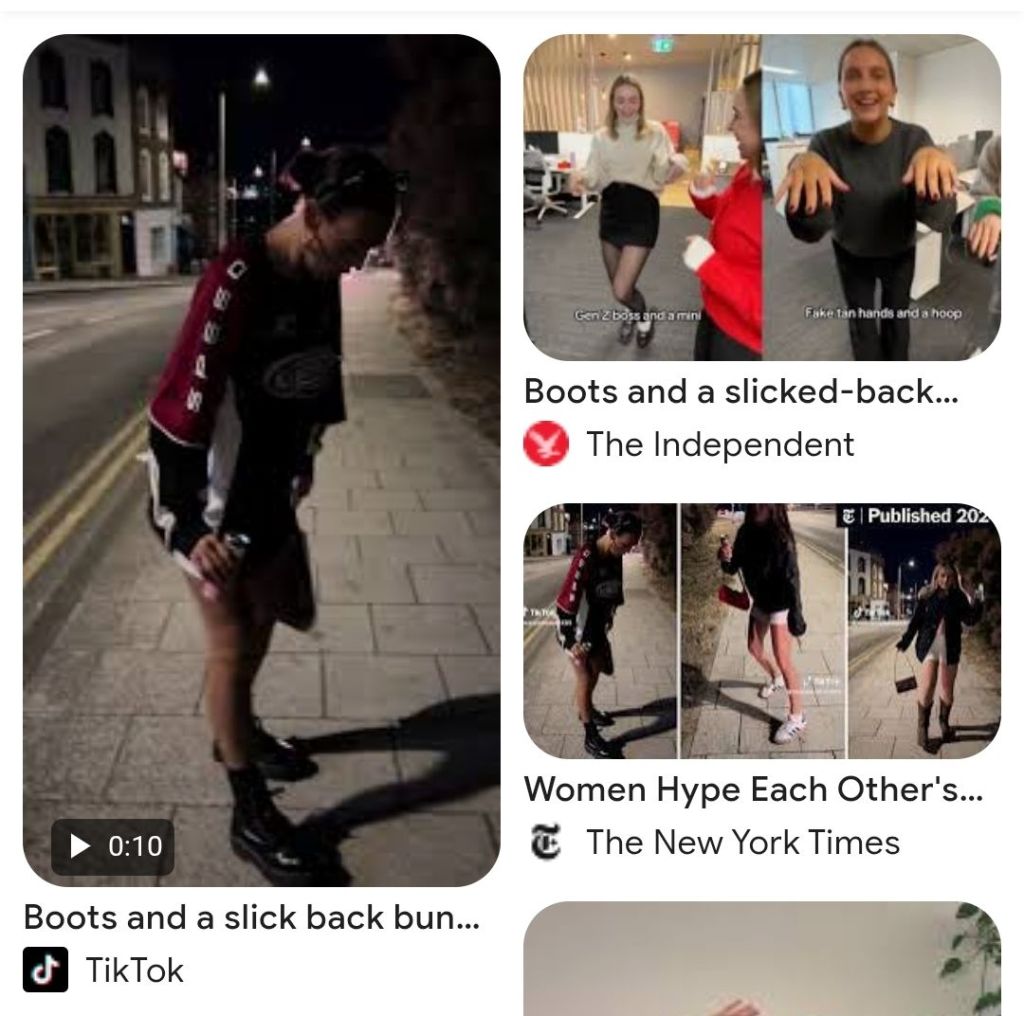
The trend was itself started by another trend video, “Boots and a slick back bun” or “Boots and a slicked-back bun”, the original of which remains on Tiktok
Why was the original video so popular? Perhaps the fashion style archetypes described resonated. Certainly, the outfits are commonly seen in London and have become almost a kind of standard uniform for young British girls.
The “lyrics” have become a shorthand to describe a look using a concise and catchy 5-beat formula that can be syncopated.
“Boots and a slicked-back bun” duh duh-duh duh duh duh
“Cowboy boots and a blowy” duh duh duh duh-duh duh-duh
“Sambas and a little red bag”duh-duh duh-duh duh-duh duh duh
The New Zealand skin care brand took the concept and extended it from the sartorial to physical and other attributes.
“Gen Z boss and a mini”
“Itty-bitty titties and a bob”
“Five foot three and a attitude”
“Secret product and a trench [coat]”
“New Frank Green and a sneaky link”
“Fake tan hands and a hoop”
Writers often use character descriptions to create an image of who a person is in the reader’s mind.
Readers/viewers often recognise such characters from their own lives, perhaps because society and families create people whose bundle of traits is so similar they could have emerged from a cookie-cutter or jelly mould.
These viral videos condense such character descriptions in an ultra concise and catchy way, making them easy to understand and process.
Of course everyone is an individual but stereotyping is something all of us do to characterise the information around us into more easily understandable chunks. Stereotyping doesn’t just apply to people but is particularly useful in any domain where there is complexity.
This technique of employing two or three key descriptors for characters is also hugely useful for writers to ensure the characters that gradually take shape in their minds become coherent and then remain consistent.
There are of course other aspects to these videos which might explain why they went viral, including the political, economic, social, legal, technological, and environmental aspects.
Clearly, from the comments at the time, a flavour of which is in the ironic reaction video subsequently released, it ‘triggered’ a lot of people and both the original content and unfiltered honest reactions to it may have connected with viewers and made them feel less isolated in their own life experiences.
A reminder that this review contains significant spoilers. Be wary that several reviews out there reveal plot points that could be considered spoilers which is disappointing but understandable because discussing the film meaningfully is difficult without getting into specifics.
To cut to the chase, I left 28 Years Later rather underwhelmed. It’s by no means a bad movie and it certainly kept me engaged for its almost 2 hour length but what were the major issues and did you share them?
Well, firstly it didn’t have the emotional resonance or uplifting quality of 28 Days Later which was a story about the nature of how families are made and end as much as being a fresh-for-the-time new style of zombie movie.
For me it wasn’t up there with the original in the way that Boyle’s Trainspotting 2 or even Top Gun Maverick was, where the film moved the characters’ life story forwards in a meaningful way. This sequel doesn’t build on any of the characters from the first movie.
The trailer was a masterpiece at building anticipation for the theatrical release but the film is a much more mixed affair that seems designed to prepare the ground for the next two movies in the 28 years later trilogy more than be a satisfying film in its own right. Cynically you wonder whether the motive was to amortise the production costs across multiple films so the same sets and actors could be reused for multiple productions, a little like the way the old big Hollywood studios used to.
The first act is a rites of passage walkabout style trip to the mainland where we see that the infected have evolved in different ways so are now less homogeneous than in the first two movies. Here we see the hallmark Garland investigation into and dystopian take on why things have come to be how they are however we never see any real explanation of why there are three kinds of infected – your regular fast one-arrow-kills, but now also super slow slithering worm eaters and ultra Viking style zombies who are hard to kill – ooh that would be a good film title, someone should do that.
Thematically, it dealt with family illness and death and curiously took what looks like a stance in support of assisted dying, though we’ll need to see the sequels to better understand Dr Kelson’s euthanasia of Comer’s character Isla which felt rather sudden with the interjection of the line about her being in pain just before she is killed by Ralph Fiennes character.
There are also clear references, which are literally spelt out on the wall, to the now disgraced UK celebrity Jimmy Saville and a suggestion of the impact of fervent religious belief on how his deviant character came to be formed.
But despite the nod to a thematic or moral basis to the story the issues kept coming. Some scenes are so different they seem tonally inconsistent; of course there’s the ending’s tongue in cheek fast cut bizarre fight scene which seemed like a pastiche of film styles from Tarantino’s Kill Bill to Guy Ritchie’s Snatch via The Matrix but equally the humorous scenes with the Swedish soldier Erike seemed like they’d been grafted in to add some light relief and a connection to our ordinary world.
Some of the dialogue is exposition heavy to the point where you wonder what the script editor was doing or whether the budget wasn’t sufficient to show rather than tell however at 75 million dollars it wasn’t a cheap movie.
It incorporated the incredibly moving and disturbing Taylor Holmes rendition of the Rudyard Kipling poem boots that features heavily in the trailer however it jarred in the film since there wasn’t any sense of a disheartening coerced march to war that Spike was being led on by his father; it felt like while his father may have wanted to bask in the limelight of his son’s over dramatised glory, perhaps to gain standing with the lady folk of the community, his motivation was genuinely to educate his son; in fact he convinces the leader to take him on the walkabout 2 years earlier than it seems was the norm. So the use of the recording was more style over substance.
More generally, music and sound is a significant part of Boyle’s movies and the sound design was immersive but the music, while eclectic from melodic vocal to thrash metal didn’t engage me like the 28 days soundtrack where John Murphy’s haunting theme was accompanied by iconic pieces like Forray’s In Paradisum and Eno’s An Ending. The soundtrack’s Remember by Young Fathers is a stunningly beautiful piece though its use in the euthanasia scene diluted its power for me.
Technically some scenes lacked visual contrast which might reflect the technical limitations of using an iPhone as the camera body with insufficiently controlled internal light reflections though that artifact didn’t have the emotional impact of the amateur home video or cctv soft grainy style of 28 days so again even in the technical decisions we see style over substance.
Getting onto plot points, the infected pregnant woman’s infant birth was clearly introduced to create a sense of hope and a final act of compassion and selflessness with the illness and death of the mother. The naming of the baby Isla after Jodie Comer’s character just hammers home a somewhat jaded message that her spirit continues.
The scolded son Spike becomes the better father and is in fact referred to by his mother as her father in some of the few genuinely touching scenes of the movie. On the other hand Jimmy, the son of the zealous priest we are introduced to at the start of the movie, in the prologue 28 years earlier we suspect has gone down a less wholesome road.
So packing in the themes to the extent they feel underdone and like tropes. The second act felt unbelievable and there is a dilapidated church sleep scene that is almost a callback to a similar scene in 28 days later however while in the first movie there were dream sequences in this there is an unexplained reality sequence where we see the consequences of what happened overnight but without any clear understanding of what exactly happened. Confusing.
There is also a blood stained scream style mask that appears on scarecrows and on a person, the significance of which isn’t made clear – the whiteness and shape made me wonder whether it was both foreshadowing and connected to the skulls we see in the Kelson skull tower memorials to the dead.
But again another loose thread in the shotgun blast of this film’s ideas. The gasolene fume filled gas station scene seemed engineered just to get an explosion. We very briefly develop a connection with the Swedish soldier Erick via an awkward partly formed gag about Scotch on the rocks but why does he deserve to die? Because he wanted to kill a baby when thinking that course of action would keep the people he cared about safe? Maybe the message is to never lose respect for the sanctity of life which is admirable but then his death happens so quickly we feel like that message is diluted. And more generally why are there navy patrols of the UK? Did the infection not spread to continental Europe as suggested in 28 Weeks Later? Either we’re asked to believe 28 Weeks Later never happened and the infection was kept confined to the UK or somehow the infected were herded to the UK for containment. In either case it doesn’t seem far-fetched to consider the isolation of the UK as an allegory for Brexit but it’s just one more not fully realised idea added into the mix.
The film did some things well.
The jump scares and scenes of sustained tension held me with editing that kept forward momentum throughout.
There was a convincing sense of civilisation having rapidly regressed within a generation to a more primitive state – an agrarian community that atavistically borrows technologies and literature from its pre-infection history.
Again maybe commentary here from Garland on how quickly a civilised world can become uncivilised.
Some performances were accomplished too, particularly from the young boy Spike played by Alfie Williams. Jodie Comer too gave a convincing performance of a loving mother struggling with disease and confusion.
So in a nutshell a curious story mix of tense horror and coming of age exploration of family dynamics with some fine performances but within a production context of permitted indulgent flights of fancy by the writer and director with tick-in-the-box sensational scenes to drive the trailer and ensure audiences get the frequent dopamine hits they’ve become used to through other mediums.
Maybe it’s nostalgia but I feel like 28 Days Later caught lightning in a bottle and this film had a go at recreating that magic but despite some accomplished performances the themes are never sufficiently focused or developed leaving us with a decent horror and some hackneyed tropes about the wisdom of the innocent untainted perspective of the child and preciousness of life – though even the latter is confused by the euthanasia angle.
Overall a rating of 6.8 for me – worth watching but without the uplifting quality or enduring rewatchability of 28 Days Later.
The music is “Wake and Break” by Oppidan whose title has a connection to the story behind the ad as reported by Marketing / Beat.
Research from the brand, which is owned by Kimberley Clark, found 75% of UK school kids do not feel comfortable pooing at school, and were risking their health because of it.
It showcased 30% of children have skipped lunch because it makes them poo and 52% don’t drink water at school to avoid it. Additionally, 45% of respondents have held their poo at school to the point of physical pain.
According to Andrex, this puts nearly 2.59 million children in the UK at risk of conditions such as constipation and haemorrhoids.
I was lucky enough to see the film at the Picturehouse Central, Piccadilly Circus, with a Q&A afterwards where the writer Raynor Winn, director Marianne Elliott and screenwriter Rebecca Lenkiewicz were joined by actor Jason Isaacs who played Raynor’s real life husband Moth.
I’m going to stick my neck out here and maybe even provoke a bit of negativity by saying this isn’t a great film.
Don’t get me wrong, I anticipate it getting a very solid if not outstanding imdb rating around the 6.7 mark but purely as a film this isn’t up there with a work of fiction like say The Shawshank Redemption or even a film based on a true story like The Pursuit of Happyness.
But if you stopped reading this review there you’d miss a lot about this film and whether you should watch it – because for all of its shortcomings I think a lot of people will enjoy this film and I’d go so far as to say love this film.
So the Salt Path is a film based on the book by the same name by Raynor Winn about a wild camping coastal walk she and her husband undertook following a sudden downturn in their financial fortunes meaning they effectively became homeless late in middle age losing all the material wealth they had worked for in life up to that point. Don’t worry by the way, there are no spoilers here and nothing I say will go much beyond what you’d glean from the trailer and film promotion interviews.
So the film is essentially a journey, metaphorically but also literally a long walk in South West England starting in Somerset and intercut with flashbacks. It’s not a glamorous Hollywood Thelma and Louise style road trip in an open top car but a rather more reserved and parochial simple backpacking walk along the admittedly equally dramatic and beautiful scenery of the England coastline.
In fact with Moth – yes that’s moth like in butterfly – the husband, he has an illness so it’s not even a straightforward walk with him often clearly struggling and his wife Raynor, the writer of the book the film is based on, literally physically supporting him.
Now the character names are rather curious but this is a true story so they aren’t made up. Moth is reminiscent of the moth that flies too close to the flame and winn is like winner which is ironic given the couple’s change of fortunes, the nature of which is gradually revealed to us in flashbacks over the course of their journey.
In the Q&A after the screening reference was made to the film being a three hander with husband and wife of course but nature as the third hand – and there certainly are some beautiful shots of the natural world which provide a variously calming and dramatic backdrop to the physical, mental and emotional challenges faced by the protagonists. Jason Isaacs made the point however that there are other characters in the film and how they perceive and treat the couple is equally telling of humans and society in general and the sometimes flawed judgements we inevitably make.
But I did like this film, I even loved it in parts but by that I don’t mean a particular narrative sequence or particular cinematic elements of the medium.
I didn’t love it particularly for the story which is engaging though not molded to conform to the traditional Aristotelian dramatic three act or epic hero’s journey form.
Neither for the acting which by Gillian and Jason especially is solid, believable and heartwarming.
Nor for the directing which gives us the shots and performances needed to tell the story.
Now Director Marianne Elliott comes from a theatre background and this is her first foray into film. In the Q&A she revealed she wanted her first film to have an older strong female protagonist and be cinematic, playing to the medium’s strengths – in fact she chose the screenwriter Rebecca Lenkiewicz for her ability to tell a story without words and the cinematography effortlessly shifts from intimate closeups of the couple to sweeping vista drone shots.
The editing in turn intrigues and satisfies to keep us engaged, the music is moving and the costume and make up well executed – I’ve never seen Anderson look so convincingly haggard in scenes and the bravery to show herself in that way reminded me of the similarly exceptionally beautiful Nicole Kidman in Destroyer.
But again none of these aspects are why I loved The Salt Path. So if not for story, acting, directing, cinematography, editing, music, costume or makeup then what?
Well, like Oppenheimer, which despite the awards and plaudits, is a very flawed film, this is an important story. It’s a story of the love and resilience of our protagonists but equally their relationship with the natural world and its power to inspire and heal us – a magical and mystical power that is all the more astonishing by being around us and familiar to us every single day of our lives.
The sense in the film of the love between husband and wife is palpable, and the characters themselves are intriguing. We are left wondering what they did in their lives up to where we meet them. Jason Isaac’s character, Moth, is an affable polymath who can as easily turn his hand to a spot of DIY as literary analysis of epic poetry.
Now the film never brought me to tears even though the trailer almost did – not least because of the transcendent life affirming score by Chris Roe. And it didn’t fill me with inspiration for what humans are capable of in the face of adversity. Neither did it thrill me with twists, turns and clever plot devices. But what it did do is leave me with a feeling. The feeling of a real sense of the love between the husband and wife protagonists. A feeling of optimism about our most intimate human relationships – by which I mean our relationships with each other but also our relationship with the natural world we are all part of.
I said this isn’t a great film. And I stand by that. There are films that employ the many strengths of the medium better. But it’s a film I enjoyed and in many ways loved. I came away from it feeling love – both for the storyteller and the truth behind the story itself.
So not a great film in the traditional sense. But a lovely film! And I wish it every success.
Aldi Shuk Up v DIY alternative meal replacement/protein shake
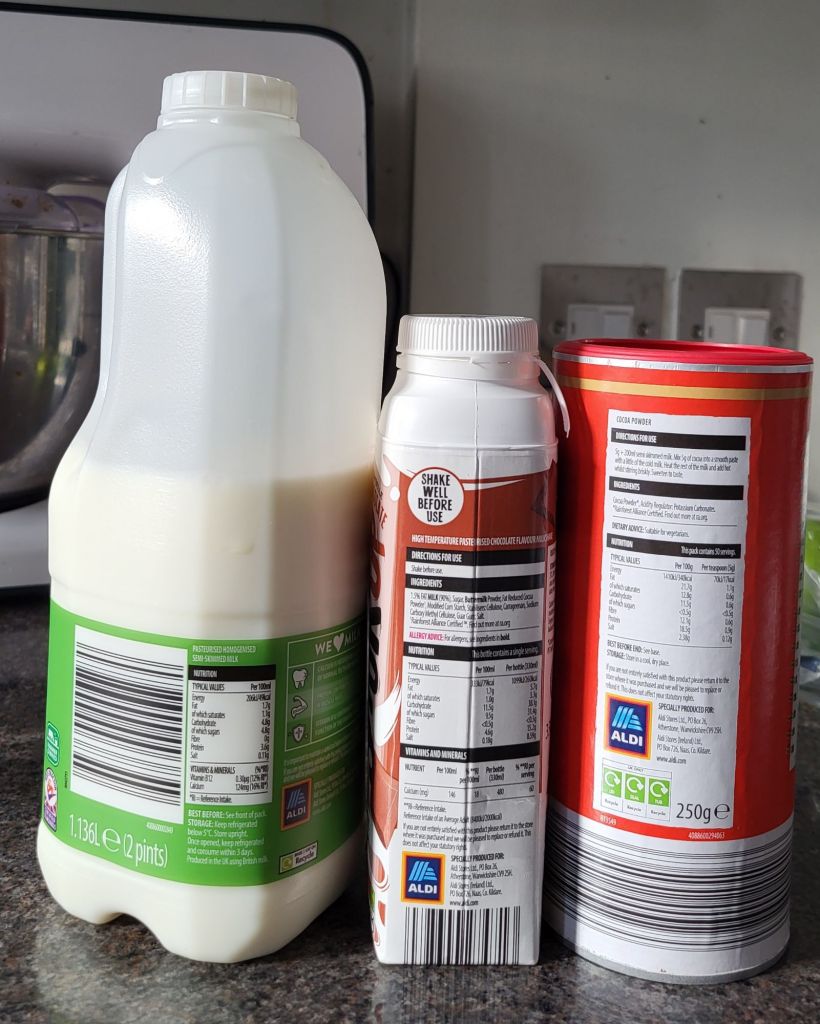
Having decided to shed a few pounds, I recently started drinking an Aldi Cowbelle “Shuk Up” protein shake (59p) for breakfast.
This, together with a multivitamin and mineral tablet (£5 for 90 = 6p each) got me a Slimfast-style meal replacement shake (£11 for 6 or £2.15 each) for a fraction (under a third) of the price.
While it contains more calories and sugar than Slimfast and a lot less fibre, it was close enough for my needs – the missing fibre can be replaced by eating an apple.
What to do when I found these shakes weren’t in stock though?
Well, it turns out that if you add 2-3 teaspoons of cocoa powder to semi-skimmed milk (first mixed into a paste with a little of the milk) you get a better meal replacement and it even works out cheaper.
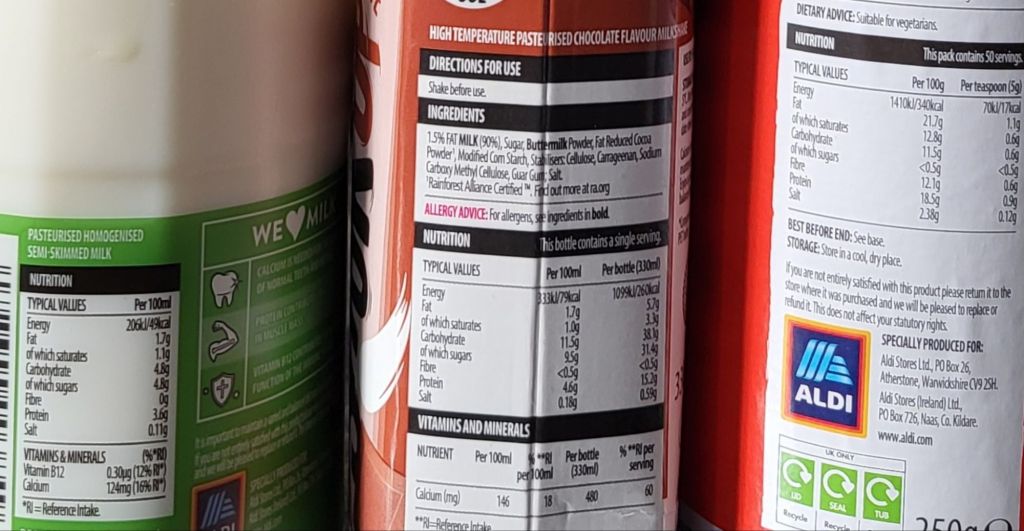
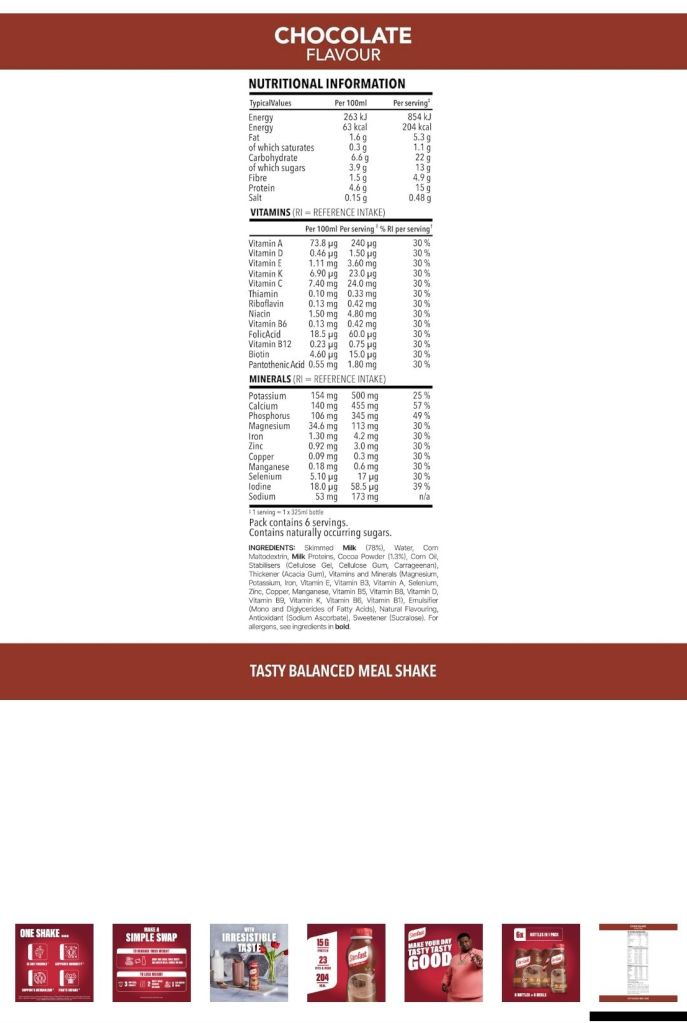
Per 100 ml, DIY protein shake (1 x 5g teaspoon of cocoa powder per 100ml milk) v Shuk Up:
Nutritional comparison
Fat = 1.7+1.1 = 2.8 v 1.7g
Carbohydrates = 4.8 + 0.6 = 5.4 v 11.5g
Protein = 3.6 + 0.9 = 4.5 v 4.6g
Fibre = 0 + 0.9 = 0.9g v <0.5g
Calories = 49 + 17 = 66 v 79 kcal.
So, same protein, more fibre, much less carb and fewer calories. Win!
Per portion it’s cheaper too (35p+3x5p = 50p v 59p), even buying milk in the more expensive 2 pint v 4 pint containers. Win!
And against Slimfast per 100ml:
Fat 2.8 v 1.6g
Carbohydrates 5.4 v 6.6g
Protein 4.5 v 4.6g
Fibre 0.9 v 1.5g
Calories 66 v 63kcal.
So a bit more fat (but fat calories don’t spike insulin like carb calories) and a bit less fibre – but eat an apple for 5g of fibre!
Yes, it’s more hassle to make and not as thick or sweet tasting (though I personally prefer that) but, taken with a vitamin and mineral pill*, a great substitute or even replacement and at a fraction of the price.
Check the many comments against this captivating piece of music, Dramamine by Flawed Mangoes, and the particular one highlighted when you click the link above.
Many of the comments are beautiful, and while this one happily nestles amongst the others, I’ve highlighted it here so that it might be discovered another way.
It narrates the journey this piece of music takes us on in a very poetic way and perhaps begins to reveal how and why music can move, affect, and even heal us.
0:00 The Opening Notes Life begins softly, a hum beneath the noise. No alarms, no blazing trumpets-just a quiet invitation to open your eyes and exist. Like the first note of this song, life often sneaks up on you, asking nothing more than to be noticed. There’s beauty in simplicity, in the way a moment can just be without needing to announce itself. Like the silence before music, the pause before you speak, or the breath you take when everything feels still. These beginnings may feel small, but they hold everything.
0:30 The Beat Finds You And there it is: a rhythm, steady and calming. This is where life starts to move, the heartbeat of your day-to-day. It’s the cup of coffee you sip in the morning, the first message you send, the footsteps you take out the door. The repetition of life can feel mundane, like you’re stuck in a loop. But loops aren’t prisons -they’re practice. Each beat is a chance to adjust, to try again, to find the flow that works for you. Think of how music needs repetition to create structure. Your life is no different. It’s okay if today feels like yesterday-what matters is how you approach it, how you let the beat carry you forward.
1:00 – The Layers Begin to Build The song grows richer now, doesn’t it? It’s no longer just a rhythm; it’s textures, melodies, and tones layering over one another. That’s life, too. It starts simple, but soon, it’s filled with responsibilities, relationships, dreams, and doubts. Sometimes it feels like too much, like you’re juggling so many parts of yourself that the weight might pull you under. But listen closely: it’s not chaos. It’s a symphony. Every layer-your struggles, your joys, your mundane moments-contributes to the music of your life. Think of it this way: even the most complex songs started with one note. Trust the process. Let the layers settle. In time, they’ll make sense.
1:30 The Groove Locks In By now, the track feels like a journey. It’s not just playing in the background; it’s carrying you somewhere. This is the part of life where you start to lose yourself in the moment. It’s the sunset walk when you stop thinking about where you’re going. It’s the conversation that flows so naturally you forget the time. These moments are rare but precious. They’re the reminders that you’re not just surviving- you’re living. When life offers you these grooves, these effortless flows, hold onto them. They’re gifts, proof that you’re exactly where you need to be.
2:00 – The Subtle Shift Do you feel it? The song doesn’t stay the same-it evolves. There’s a shift in the tone, a quiet change in direction. Life works the same way. Growth isn’t always a grand revelation. Sometimes, it’s a whisper, a nudge, a moment so subtle you don’t notice it until later. You’ll look back on these shifts-the job you didn’t get, the friendship that drifted, the unexpected opportunity-and realize they were the turning points. Change is uncomfortable, yes, but it’s also inevitable. Let it happen. Trust that you’re moving toward something better, even if you can’t see it yet.
2:30 The Echoes Return Listen closely. Do you hear it? The earlier notes are back, but they’re different now. They’ve grown, evolved, transformed. That’s how life works, too. The past doesn’t vanish- it echoes. The things you’ve lived through, the lessons you’ve learned, they return in new forms. Maybe it’s a memory that resurfaces, a feeling you thought you’d forgotten, or a challenge you’ve faced before. These echoes aren’t here to haunt you. They’re here to remind you of your strength, to show you how far you’ve come.
3:00 The Build to the End The track is winding down now, but it’s not fading-it’s transforming. This part of the song feels reflective, like it’s asking you to take stock of everything you’ve heard so far. Life does that, too. It gives you moments of pause, opportunities to step back and see the bigger picture. Endings can feel bittersweet, but they’re also full of potential. A goodbye is never just a goodbye-it’s a chance to start again. The end of this track isn’t silence; it’s the start of the next one.
3:30 The Final Note And now, the song fades into quiet. The last note lingers, leaving you in a space that feels both empty and full. This silence? It’s not the end-it’s the beginning of whatever comes next. Your life is a playlist, and this track is just one of many. You’ll hear it again, find new meaning in it, and let it guide you in different ways. But for now, let this stillness remind you of one thing: you’re the composer. The next note, the next melody, the next song—it’s all up to you.
Life Lessons: In life, as in music, even the quietest start has the potential to bloom into something unforgettable. Repetition isn’t stagnation; it’s where mastery begins. Complexity is not your enemy-it’s where depth and meaning are born. When life syncs perfectly with your rhythm, don’t overthink it. Just let it carry you. Growth is quiet, but it’s constant. Trust the process, even when it feels invisible. The past isn’t a shadow-it’s a mirror. Look at it to see how much you’ve grown. Endings aren’t finales-they’re transitions to something new. In the silence between moments, you hold infinite possibilities.
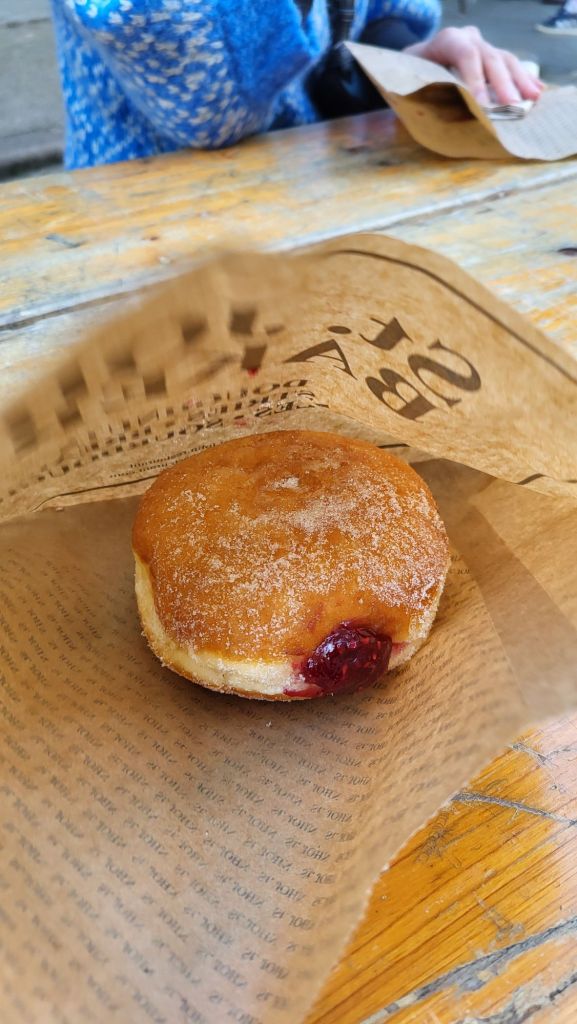
Who doesn’t love a doughnut? A simple treat but one that St John’s in Druid Street, London SE1 has taken to another level.
A delicious sweet treat whose faintly crisp sugar-sprinkled outer conceals a yielding light fluffy but satisfyingly chewy centre filled much more than generously with a mouthwateringly fruity and citrusy seeded raspberry jam.
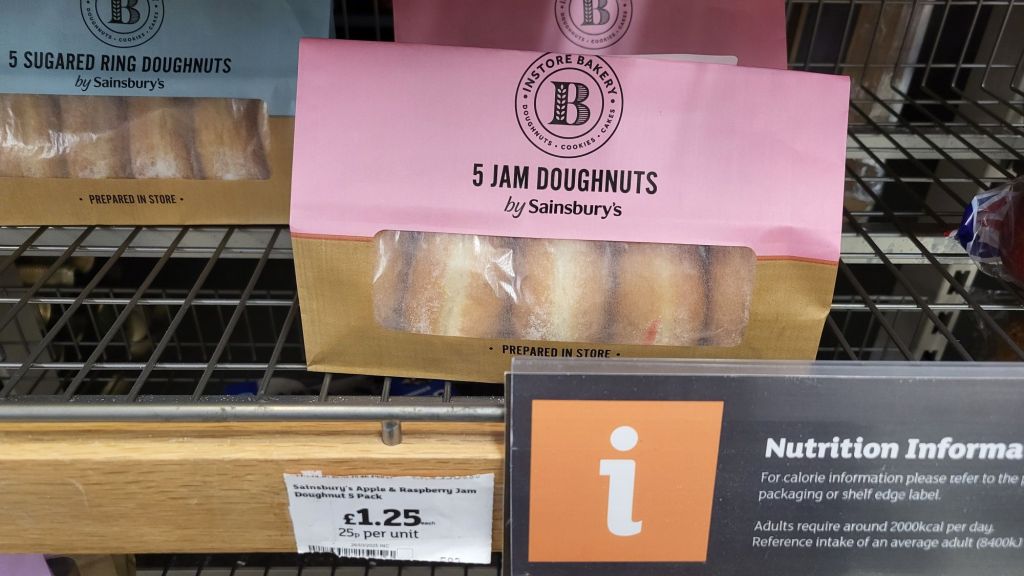
They’re certainly not cheap at £3.90 each – a packet of 5 bog standard jam doughnuts costs £1.30 in Sainsbury’s!
But even at 15 times the price of some other confections of the same name, I’d have to say these are such a qualitatively different experience that to call all of these doughnuts is just to reveal the paucity of the English language in this realm.
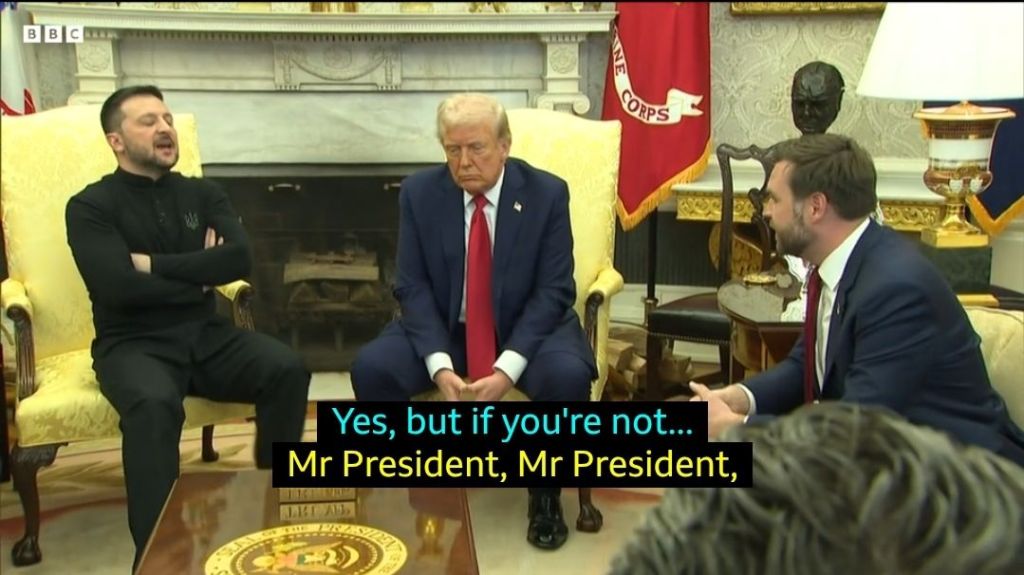
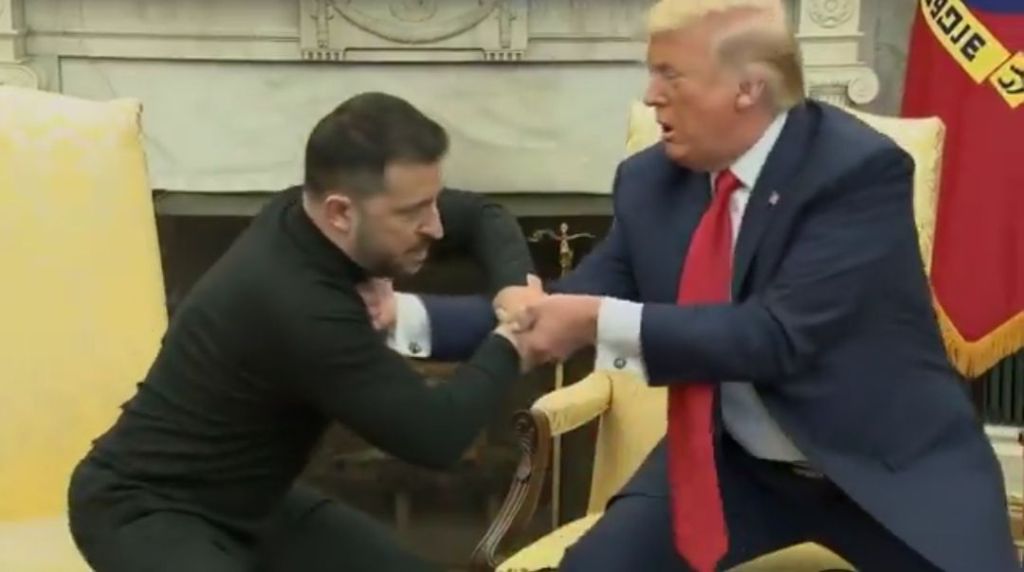
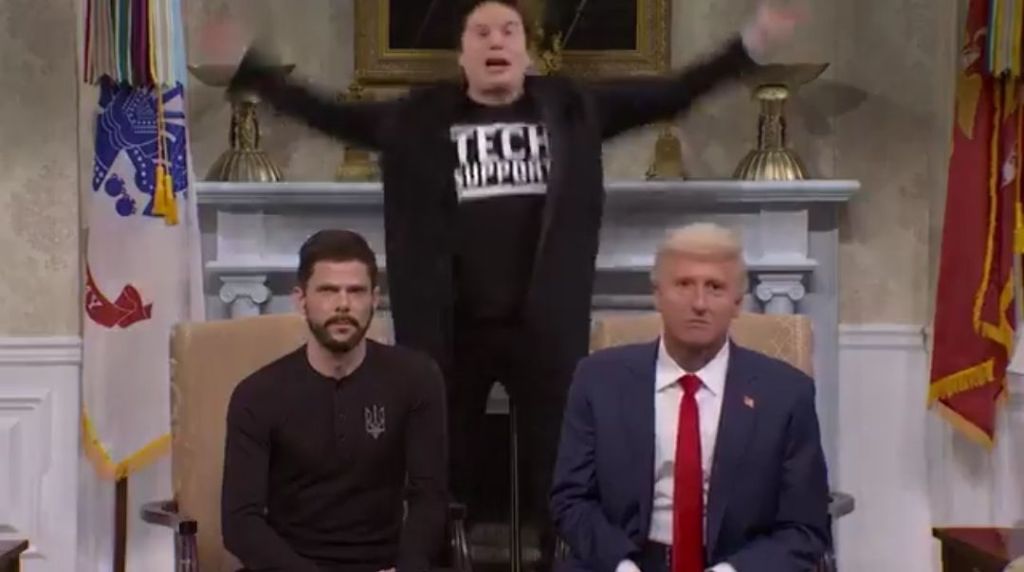
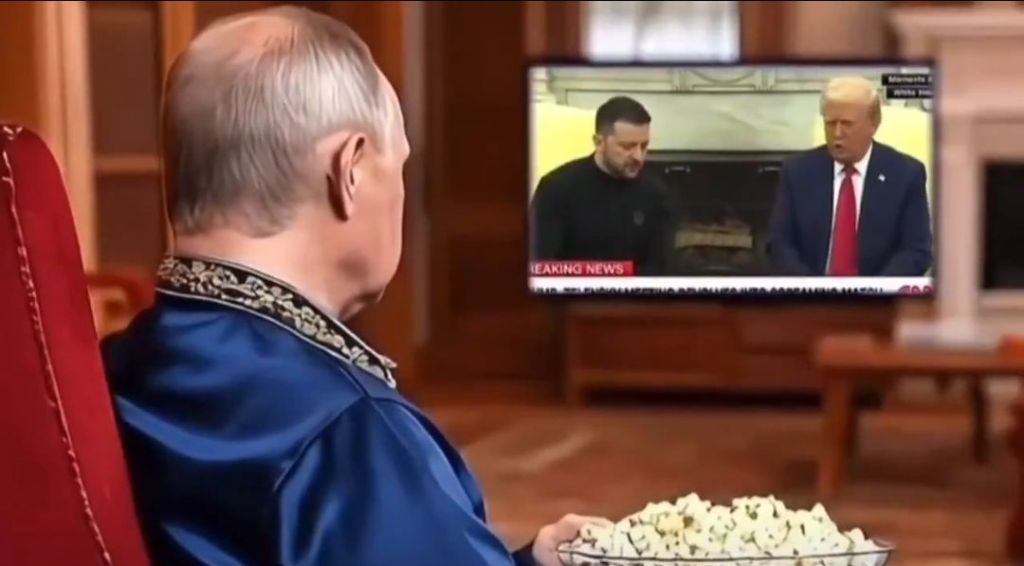
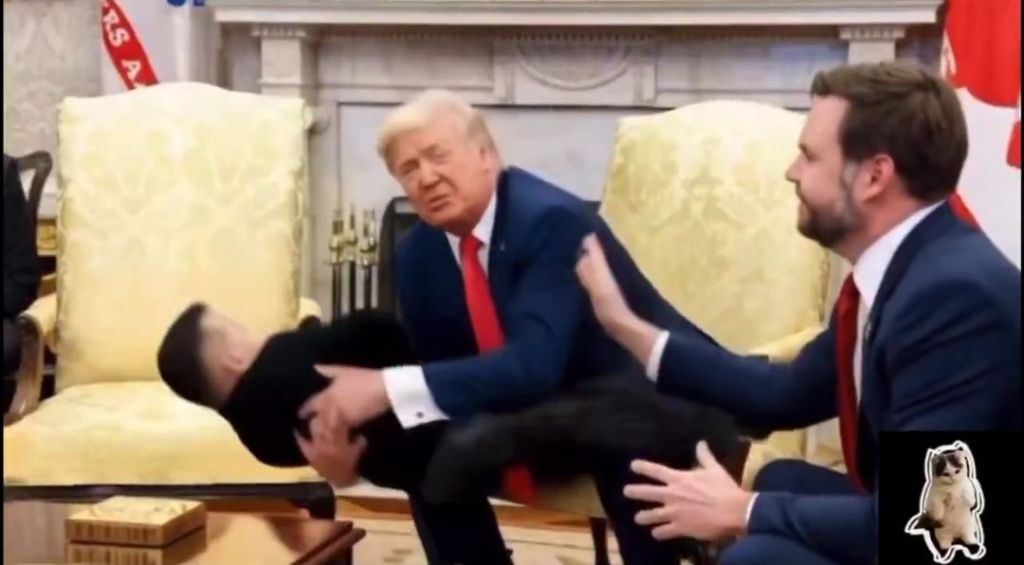
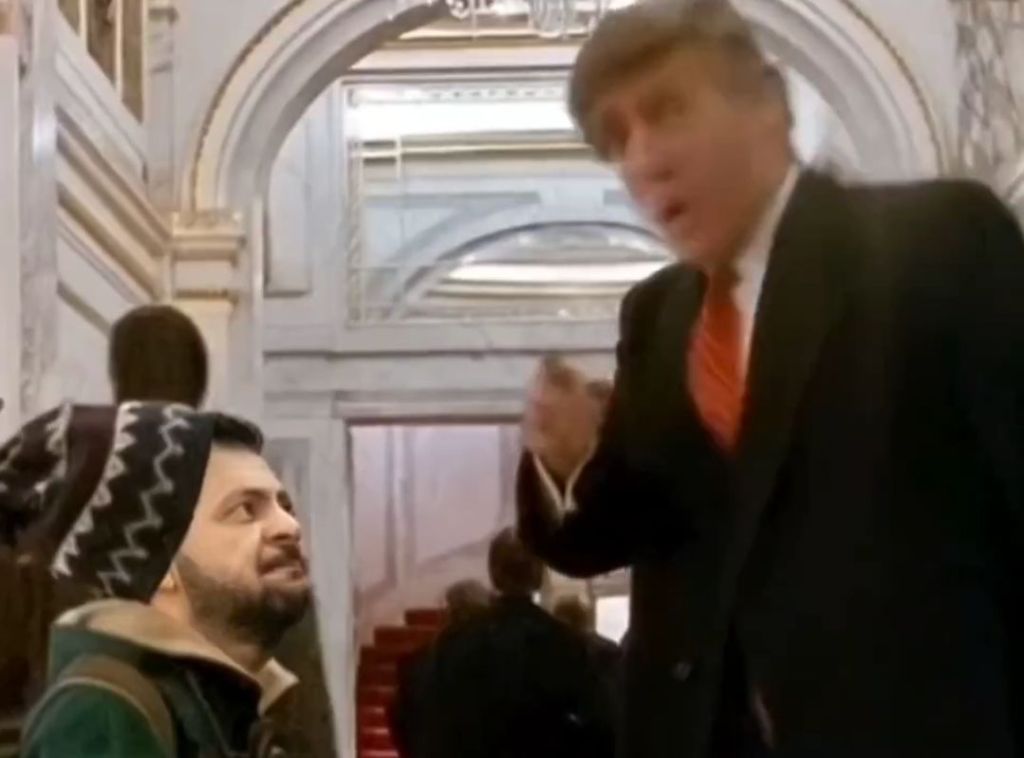
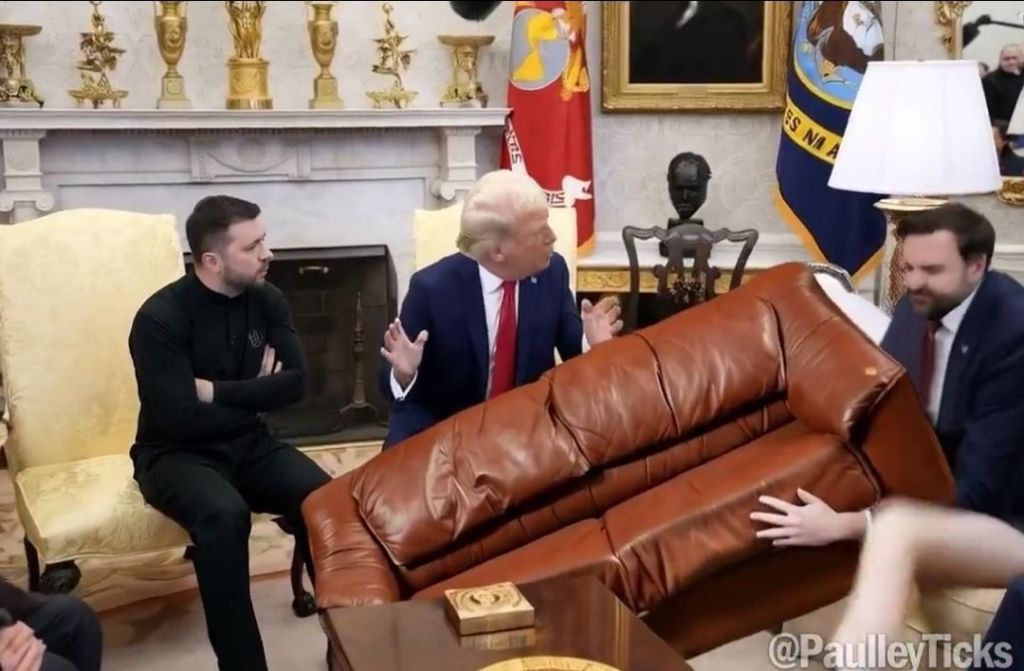
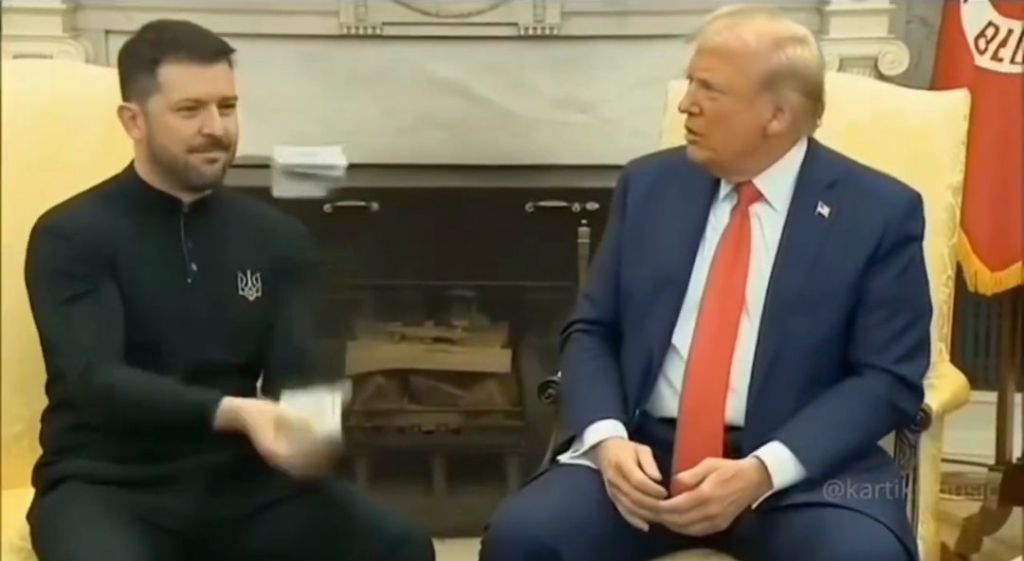
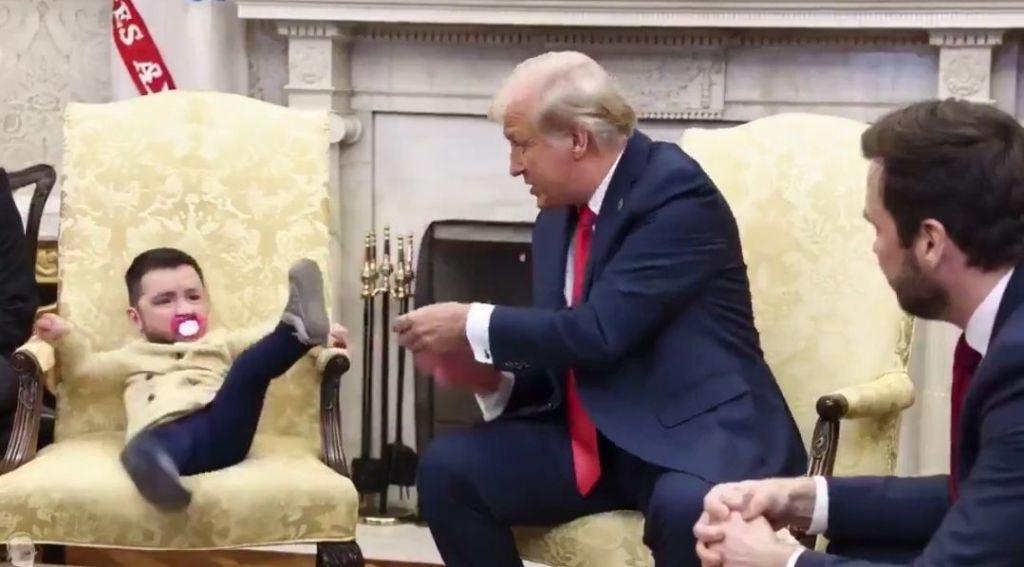
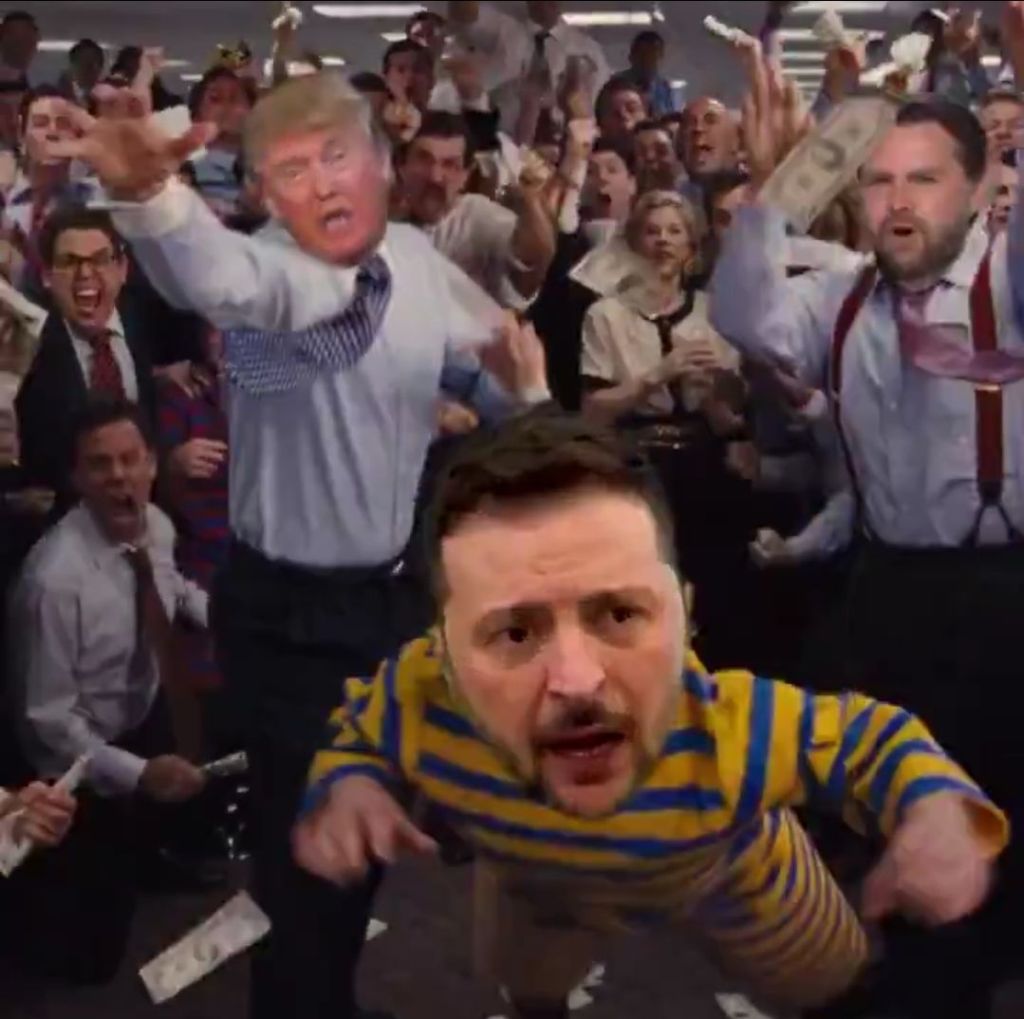
There are a LOT of meme videos stemming from the now infamous televised meeting of presidents Trump and Zelensky (/Zelenskyy) in the White House on 28th February 2025.
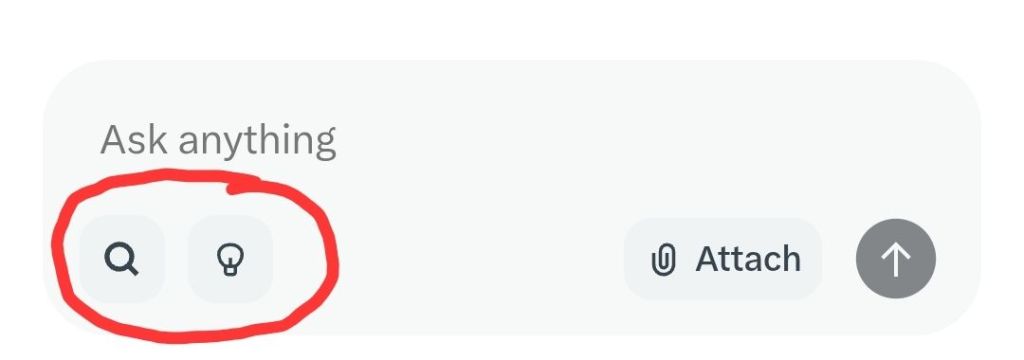
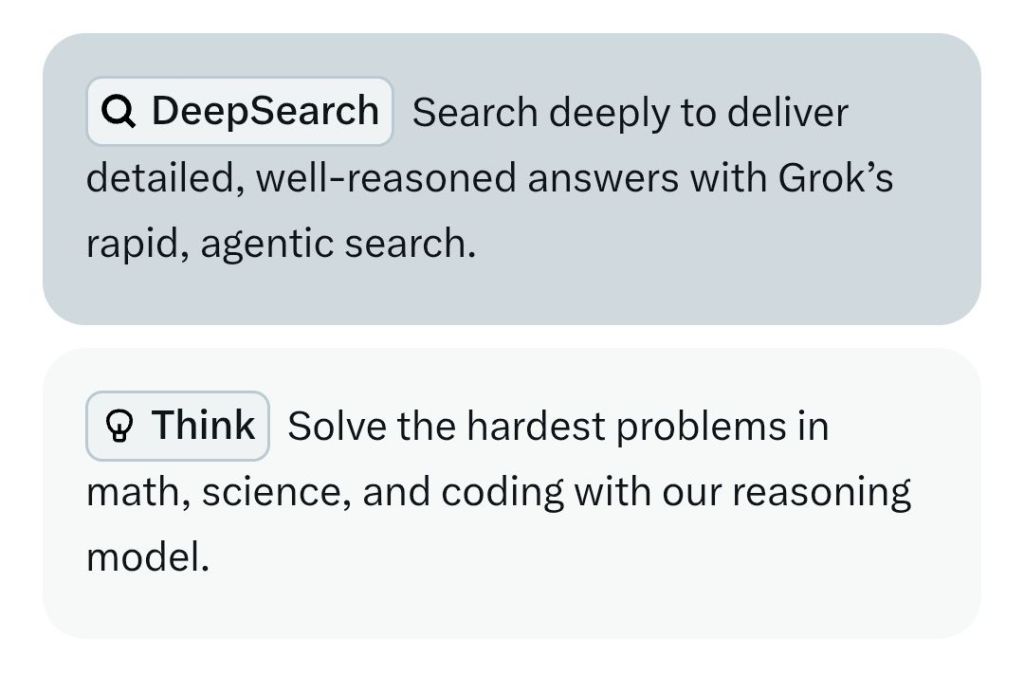
If you’re wondering what difference toggling the two icon buttons in the Grok 3 beta search box makes, it’s actually explained at the top of the Grok interface when creating a new conversation however it’s not obvious and their meaning is not shown thereafter.
Grok deep search and think
Touching the light bulb means Grok uses and shows a train of thought as it processes the text you enter in the input box which mode of operation lends itself to questions and problems whose resolution require a sequence of reasoning steps like mathematical solutions.
Touching the magnifying glass means Grok performs deeper ‘agentic’ (think ‘agency’ i.e. having the power to takeaction) real-time web search and step-by-step research as part of processing your input to deliver more up-to-date nuanced answers.
It looks like you can toggle either one or the other or neither – in which case it still seems to search current web sources as well as those it’s been trained on.
Grok toggle icons
Hope this helps – check out and subscribe to my YouTube channel for more tech and wellbeing content.
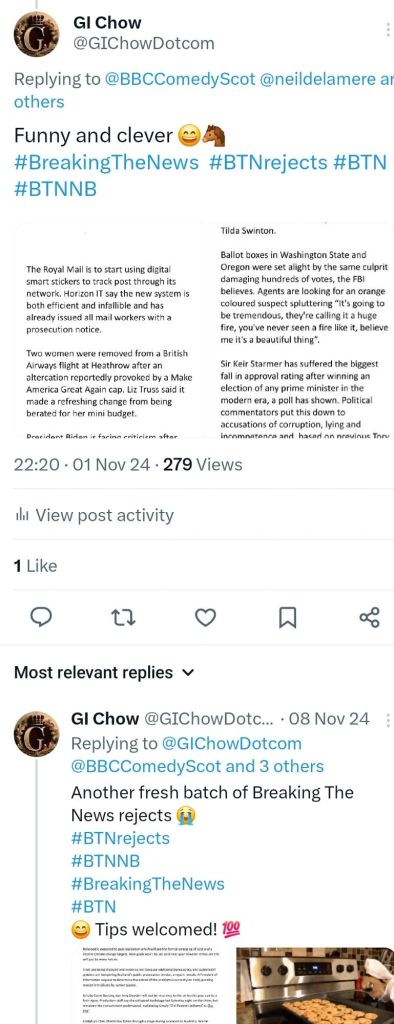
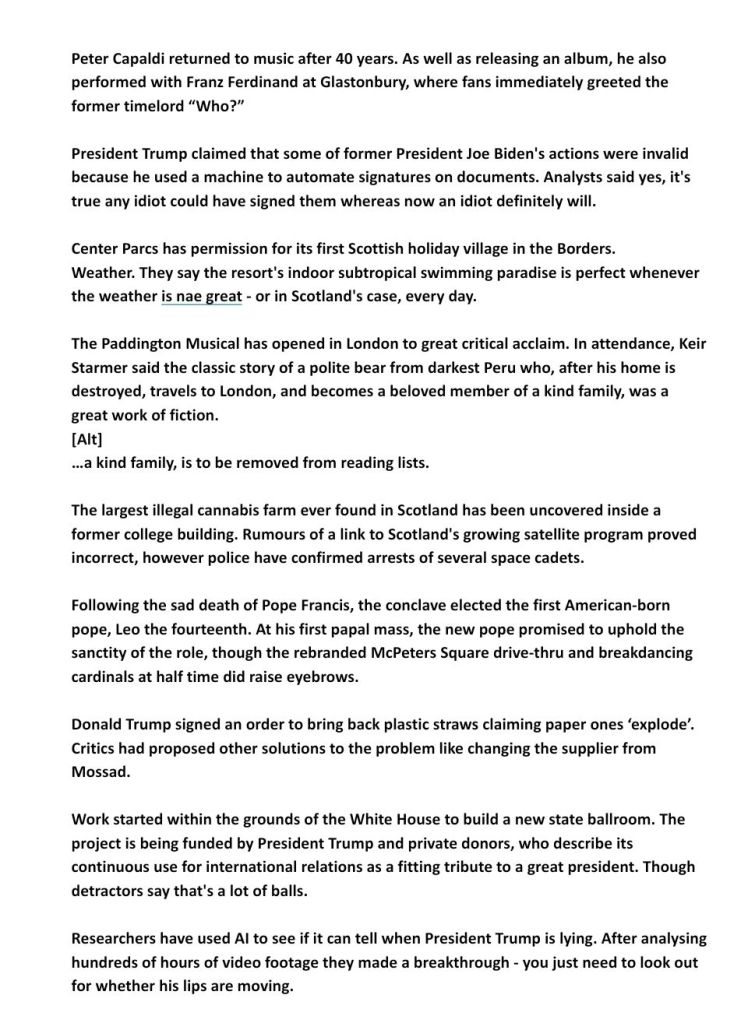
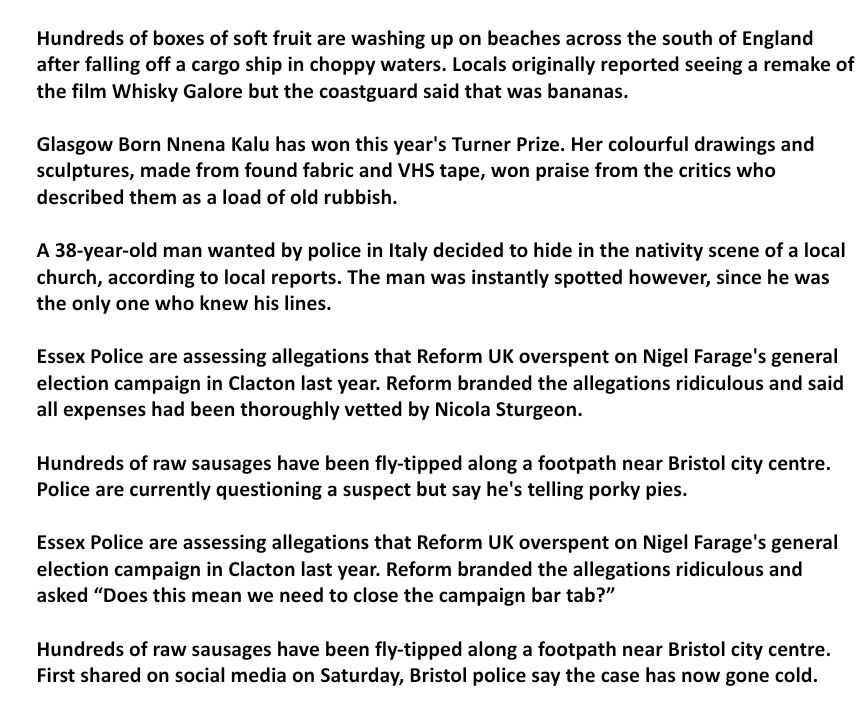
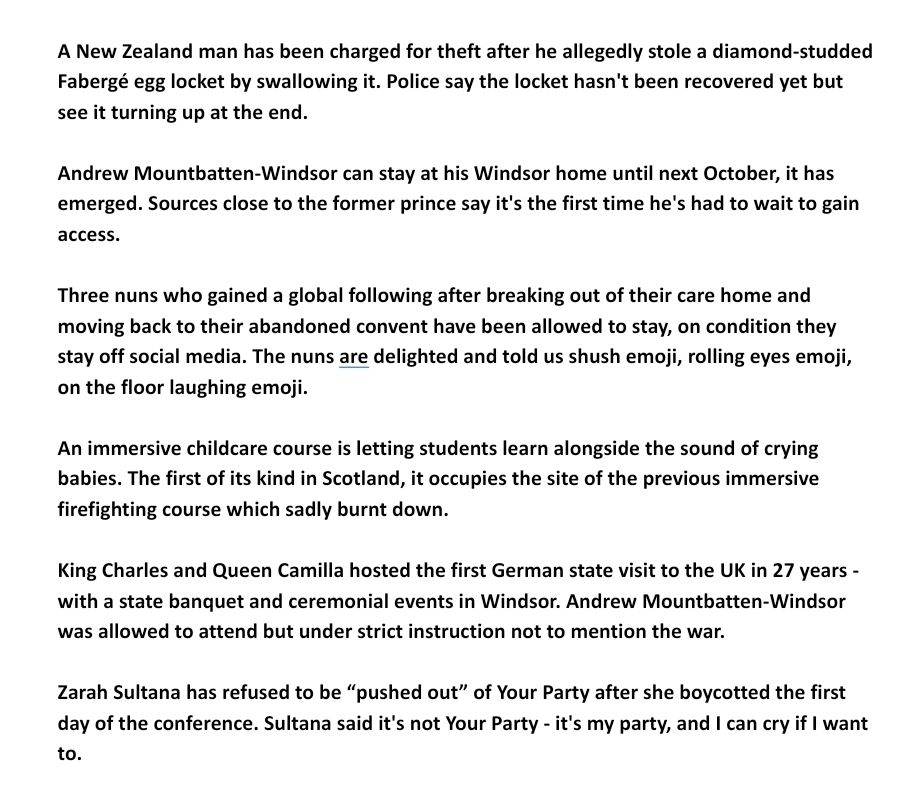
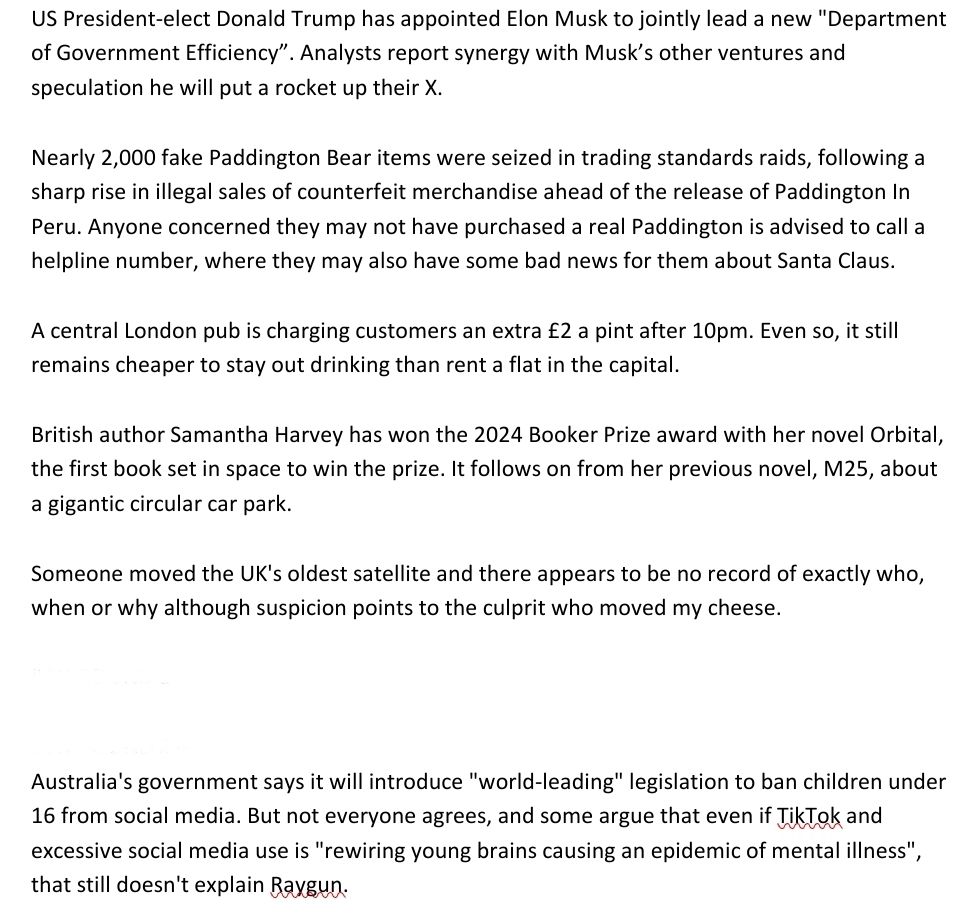
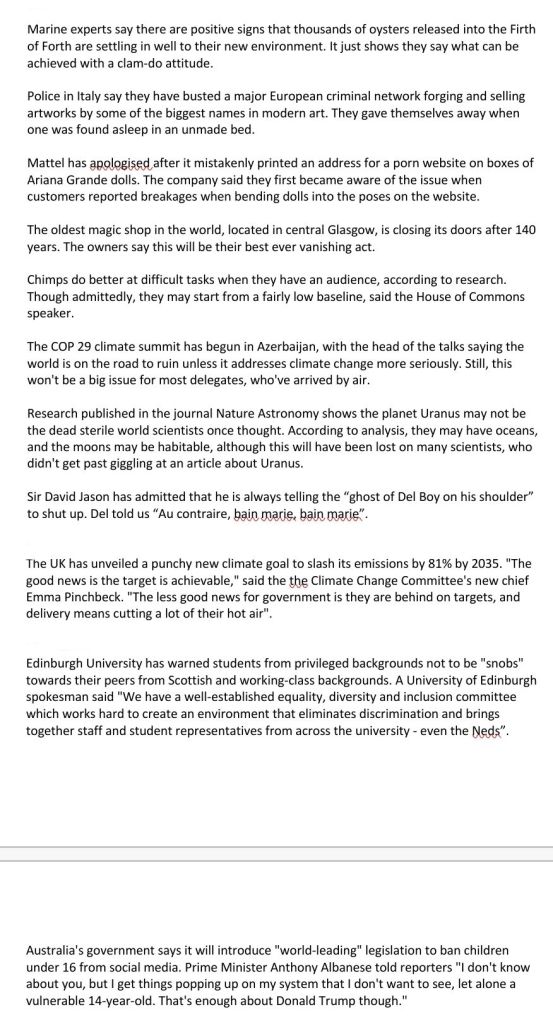
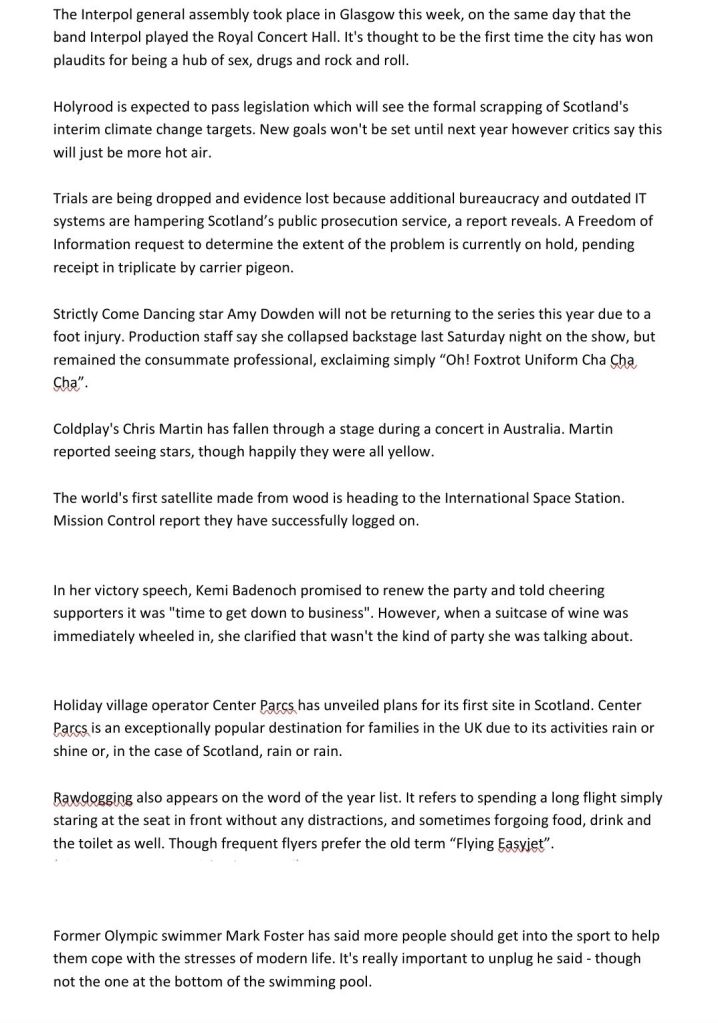
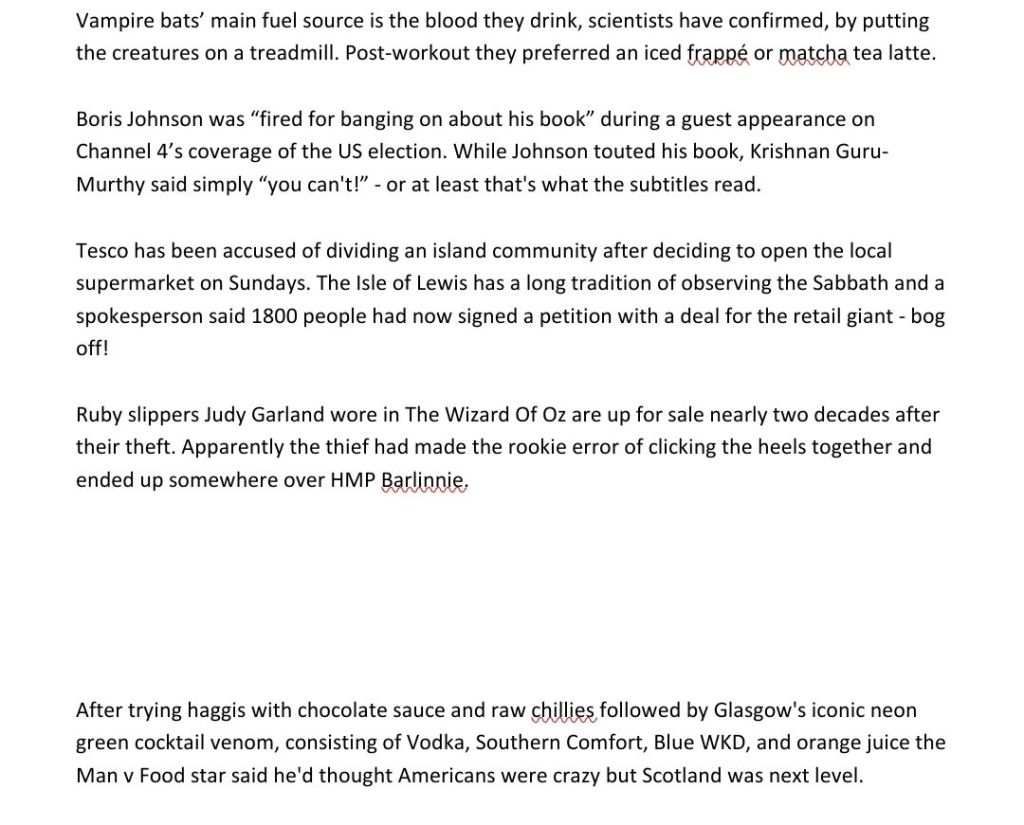
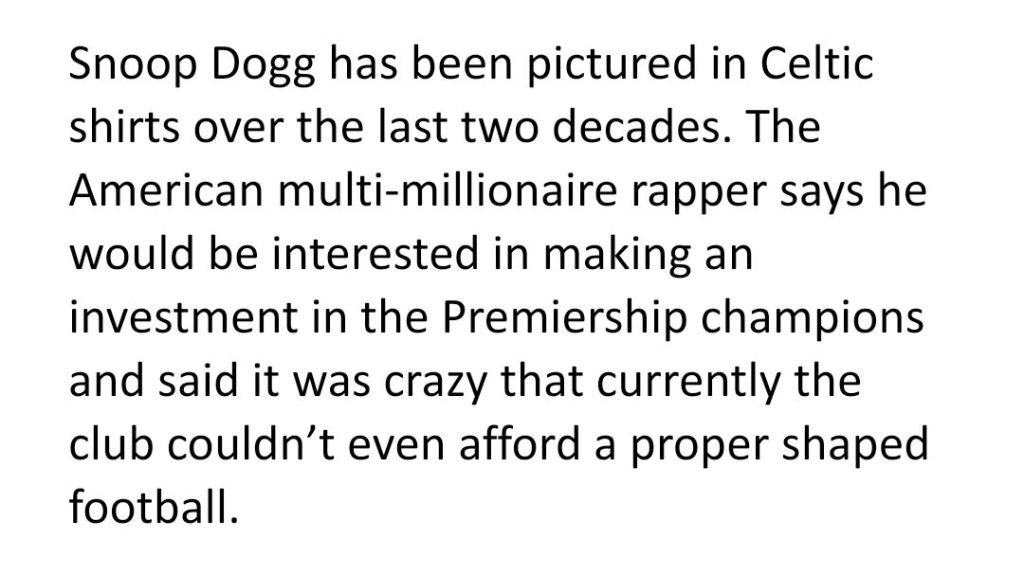
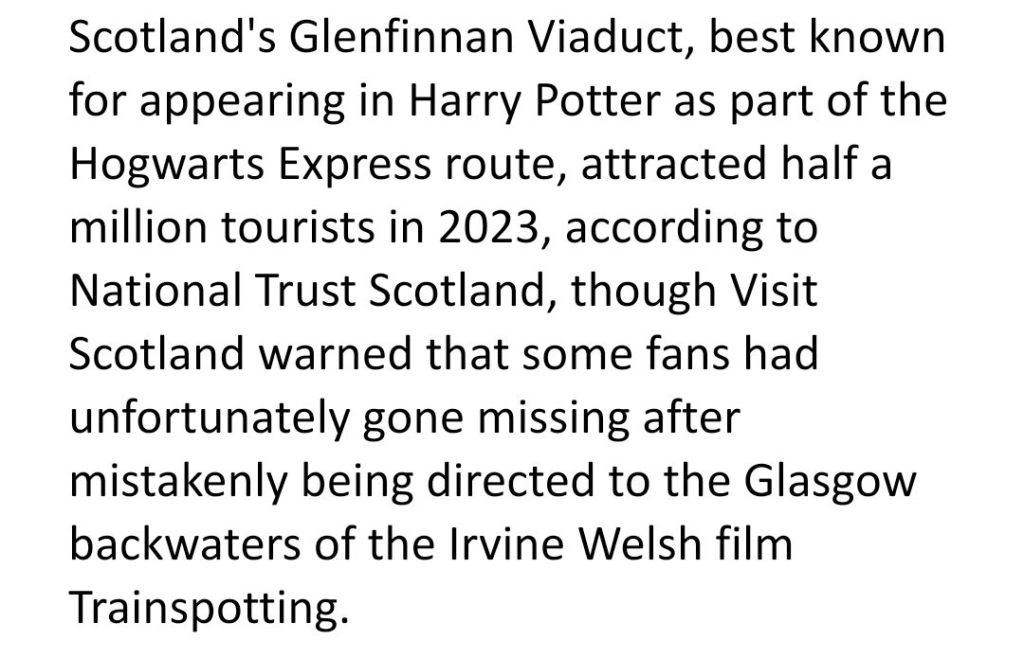
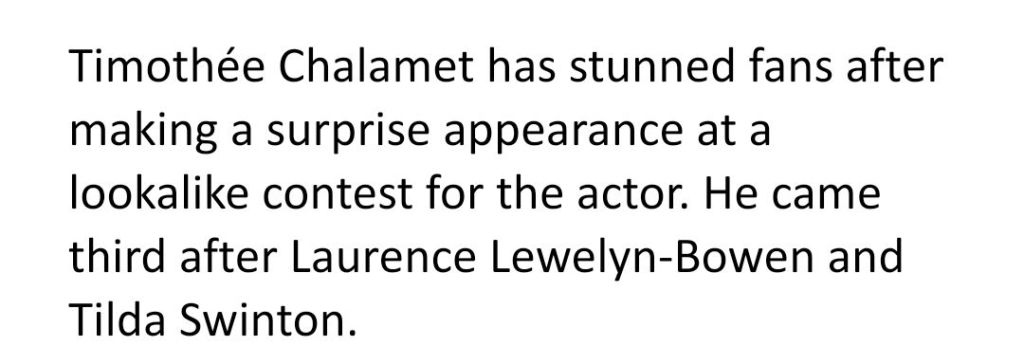
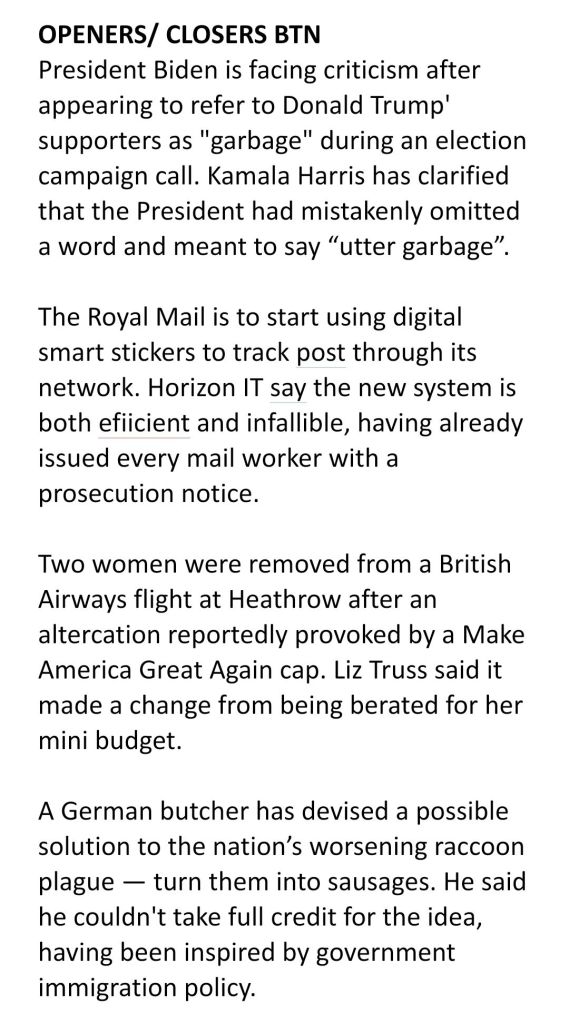
Several comedy writers “tag” their rejected submissions to BBC topical news comedy shows in social media posts using a hashtag like #BTNRejects, #BTNNB, #BreakingTheNews, #NoisingUp, etc. so other writers can see and provide feedback on or like their ideas.
Here’s a thread of some of my news gag failures on X.
I’ve gathered together here well over 100 rejects so we can see what didn’t make the grade and maybe learn something about what doesn’t work in the process – comments welcomed!
You are free to use any of these in your online content with a credit linking to https://x.com/GIChowDotcom (lmk and I will share your content on my socials!)
And for what it’s worth here’s a completely AI generated video on how to write topical gags!
Write topical jokes for Twitter & TV
Caribbean Airlines confirmed a passenger on a flight from Jamaica to New York gave birth just as the flight was landing at John F. Kennedy Airport. The proud mum said the delivery was beautiful and surprisingly painless, though she did wince at the extra carry on luggage charge.
A Tesco store in Kirkwall has been giving away bananas after accidentally ordering around 38,000 of them, almost twice Orkney’s population. It’s not yet clear how the mistake happened, as one resident said “it’s bananas”.
Swiss food giant Nestle says about 12 tons, or 413,793 bars, of its KitKat chocolate brand were stolen after leaving its production site in Italy earlier this week for Poland. Police have arrested a suspect and believe it’s just a matter of time before he snaps under questioning.
A Michelin star chef has unveiled a ten point pledge to tackle sexism in restaurants. He said there are actually twenty six points but was keeping it to a number the wee lassies can understand.
Former Google executive Matt Brittin has been confirmed as the BBC’s new director general. The hunt for a new DG threw up several highly experienced candidates but insiders say Brittin came top on the first page of search results.
Students at a Scottish university have been asked to design a tartan to mark the 250th anniversary of the American Declaration of Independence. The current front-runner eschews the traditional colour palette in favour of a contemporary tan orange with hints of bin fire.
A message in a bottle dropped from a boat off Canada has been found washed up in the north-east of Scotland. While the full contents of the message have yet to be disclosed, the finders could reveal it starts “Dear Donald” and ends with “off”.
A ‘self-cleaning fabric’ could cut laundry time by 80%, say scientists in China, who have created a special coating for clothing that enables them to be cleaned using a simple rinse cycle with no detergent. The news came as no surprise to canny Glaswegians however, who said they’ve been doing laundry that way for years.
Graves more than 100 years old could be reused across England and Wales under Law Commission proposals that also include the reopening of some burial grounds closed under Victorian-era legislation. Marketing of the graves is already underway with a BOGOF deal – bury one, grave one free.
A Chinese shipyard has been named as the preferred bidder to build two new “freight flex” vessels serving Orkney and Shetland. In what’s thought to be a world first, drop shipping will be used to deliver shipping.
Scottish supercomputer ARCHER2 is value for money, according to a report just published. It concludes that the breakthroughs delivered justify spending public money on the next generation of supercomputers – though careful readers did spot a footnote saying “written by ARCHER2”.
One hundred lucky fans have bagged tickets to Harry Style’s one-off concert in Manchester, thanks to a gift from the star to his old school. Headteacher Nigel Bielby said the lucky ticket winners were randomly selected from applicants at the school, while the unlucky ones got two tickets.
The Italian baseball team has attracted attention online when it was discovered that the team kept an espresso machine in its dugout. Other teams didn’t mind the caffeine hit giving them an unfair advantage, but drew the line when their batting lineup started with George Clooney.
Australian designer Katie Perry has won her High Court appeal against pop megastar Katy Perry in a years-long trademark case. Both sides presented lengthy technical arguments for their case, though Katy Perry, the pop singer’s counsel did end with fireworks.
A “tea planter” jailed for buying tea from around the world and passing it off as grown in Scotland made over a million pounds from his criminal conduct, a court has heard. Suspicions were aroused when someone pointed out Scotland’s got nae blooming sunshine.
MARTIANS could be humans’ ancestors, scientists have said, after finding that alien microbes could travel on asteroids from other planets. Critics pooh-poohed the idea however, one saying “the simplest life forms could never have come from microbes – you’ve only to look at the American administration”.
MSP’s have heard a troubled Scottish ferry needs new propellers as part of multi-million pound repairs after just over a year in service. One passenger said the repairs couldn’t come soon enough, as the daily row was starting to take its toll.
United Airlines recently announced that anyone playing phone audio without wearing headphones can be denied transport and, in extreme cases, permanently banned. The new rule has already caused problems, however, when on the landing approach, a call came in for the pilot.
Ryanair has been voted the worst short-haul operator in the UK as passengers criticised its poor customer service, difficult booking process and uncomfortable seats. A Ryanair spokesperson said “We can’t believe it! It’s the first time we’ve won anything!”
The Scottish justice system has been told it’s time to enter the twenty-first century after a review found that courts are still using second class post to summon witnesses. A spokesperson said it would be their number one priority, just as soon as they work out what to do with the ducking stools.
After her spouse David Taylor was arrested on suspicion of spying for China, Scottish Labour MP Joani Reid said she’s never seen anything to make her suspect her husband had broken any law. Though did wonder why they’d been getting so many phone calls asking for the Chinese takeaway.
Three-time world snooker champion Mark Williams has revealed he has a ‘serious phobia’ of tea bags. One theory is that the fear stems from the eponymous witch in the 80’s Children’s show “T-Bag” – which could also explain his other fears of rhubarb and custard.
A study has revealed that three quarters of young daters prioritise environmental values as much as physical compatibility. For Gen Zs, it seems, green views are as important as good looks, which is great news for ugly guys with lots of wind.
Hannah Spencer is a plumber, a qualified plasterer, and the woman who has just become parliament’s newest MP in a historic series of firsts. She said she’ll never forget where she came from and can’t wait to start holding surgeries. Though won’t be available for at least three weeks, and there’s an £80 callout charge.
Chocolate bars are being locked in plastic boxes in some UK shops as police forces warn thieves are stealing them to order. The boxes make them hard to conceal, which is good news for retailers, but bad news for the man from Milk Tray.
More than 15-hundred pieces of film and television memorabilia are to be sold at auction next month. The lots include the harpoon gun from Jaws and a helmet worn by Russell Crowe in Gladiator, which have already raised interest from UK border control.
GP practices in England are to be paid £3,000 a year bonuses to prescribe weight loss drugs. Patients are advised the cash-for-prescriptions drugs won’t work for some groups, however, including big pharma fat cats.
Former US President Barack Obama has clarified that the chances Earth has been visited by aliens is “low” after comments he made about extra-terrestrial species caught attention online. The confusion arose when he mentioned the film Predator, but it turned out he meant Jeffrey Epstein.
Liz Truss has met with Donald Trump at his residence in Mar-a-Lago, sharing a photo of the moment on social media. She captioned the image “right about everything”, to which the internet quickly added “just be Cos”.
A 70-year-old former trading standards officer is to compete in the world axe and knife-throwing championships after teaching himself the sport in his own garden. His neighbours are said to be thrilled, as one asked “does this mean we can let the cats out now?”













 GI Chow